
Real Estate SEO Case Study: Bedford Estate Agent "Page 1 Rankings in 6 Months"
An independent Bedford estate agent achieved page one Google rankings for high-intent property keywords within 6 months through a focused local SEO strategy — generating 120% organic traffic growth, 900+ monthly clicks, and 190+ qualified enquiries without paid advertising.
+
5
%
Organic Traffic Growth
in 5 months
Keywords
70
Page 1 Rankings
from 0 to top 10
Days
Time to Results
first page rankings
Meet The Author

Ayesha Batool
Ayesha Batool is a Real Estate SEO Specialist with 5+ years of experience helping UK estate agents, property investors, and brokerages rank on Google and get cited in AI search engines like ChatGPT and Perplexity. She has delivered 50+ real estate SEO projects across 10 markets including UK, USA, and Dubai — working exclusively with property businesses. Her approach combines SEO with AEO so clients rank on both Google and AI search engines simultaneously.
Most real estate agents rely entirely on Zillow, Realtor.com, and paid Facebook ads to generate leads. But when the ad budget dries up, so does the pipeline.
This case study documents how I helped a residential real estate agent — operating in a competitive mid-sized U.S. city market — build a sustainable SEO presence from the ground up. Within 5 months, this agent went from having virtually zero organic visibility to ranking on Page 1 for 17 high-intent keywords, including competitive phrases like “[City] homes for sale” and “buy a home in [City].”
real estate niche.
The results were achieved with no paid advertising, no major link-building campaigns, and no technical overhaul — just a focused content and local SEO strategy built for the
real estate niche.
Client Background
To protect client privacy, specific identifying details have been anonymized.
|
|
|
|---|---|
|
Industry
|
Residential Real Estate
|
|
Business Type
|
Independent Real Estate Agent (Solo)
|
|
Market
|
Mid-sized U.S. metropolitan area
|
|
Competition Level
|
High — dominated by major portals & large brokerages
|
|
Starting Organic Traffic
|
~900 monthly visitors
|
|
Starting Keyword Rankings
|
100 keywords in top 50
|
|
Engagement Duration
|
6 Months
|
The Problem
When this client came to me, they had a website — but it was essentially invisible to search engines. Their situation is one I see constantly with independent agents:
- 100% of leads came from referrals and paid social media ads
- The website had no blog, no local landing pages, and thin content on every page
- Zero keyword rankings in Google’s top 50 results
- They were spending $800–$1,200/month on Facebook ads with inconsistent ROI
- Large competitors (Zillow, local brokerages with 20+ agents) dominated every relevant search
The core challenge: how do you compete with billion-dollar platforms and large agencies when you are a team of one?
The answer is not to outspend them — it is to out-niche them. Solo agents can rank for hyper-local, buyer-intent keywords that big platforms ignore because they are too specific.
Phase 1 — Keyword Research & Strategy
Finding the Right Keywords
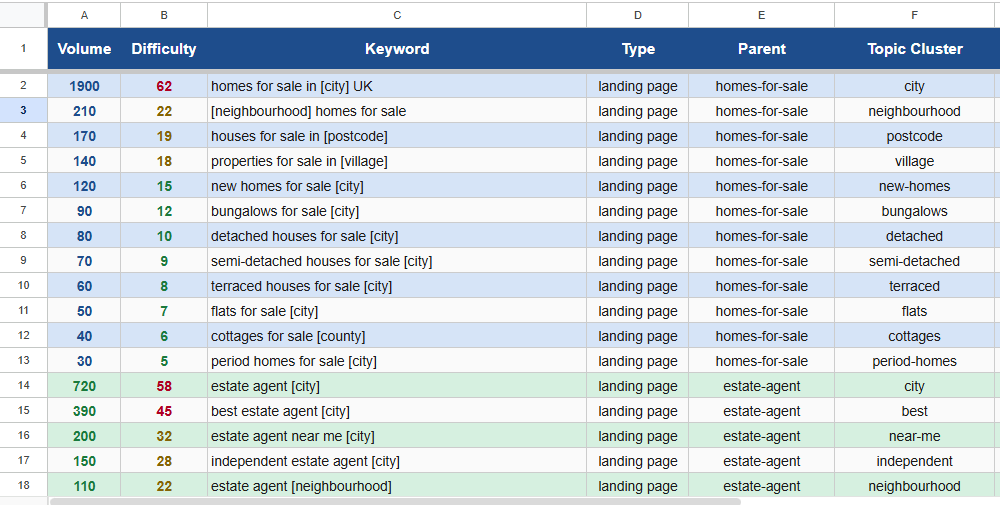
Before writing a single word of content, I spent the first two weeks doing deep keyword research specific to the client’s city and surrounding neighborhoods. The goal was simple: find keywords with real buyer intent that large portals were NOT fully dominating.
I used a combination of Ahrefs, Google Search Console, and manual SERP analysis to map out keyword opportunities in three tiers:
Tier 1 — Keyword Research & Strategy
- [City] homes for sale | Volume: 1,900/mo | KD: 62
- buy a house in [City] | Volume: 880/mo | KD: 54
- [City] real estate agent | Volume: 720/mo | KD: 58
Tier 2 — Neighborhood Keywords (quick wins)
- [Neighborhood] homes for sale | Volume: 210/mo | KD: 28
- homes for sale near [School District] | Volume: 170/mo | KD: 22
- [Zip Code] real estate | Volume: 140/mo | KD: 19
Tier 3 — Buyer Intent Content Keywords
- first time home buyer [City] | Volume: 590/mo | KD: 35
- how to buy a home in [City] | Volume: 320/mo | KD: 30
- best neighborhoods in [City] to buy a home | Volume: 260/mo | KD: 24
The strategy was to target Tier 2 and Tier 3 keywords first to build authority quickly, then use that authority to push into Tier 1 rankings over time.
The Content Architecture
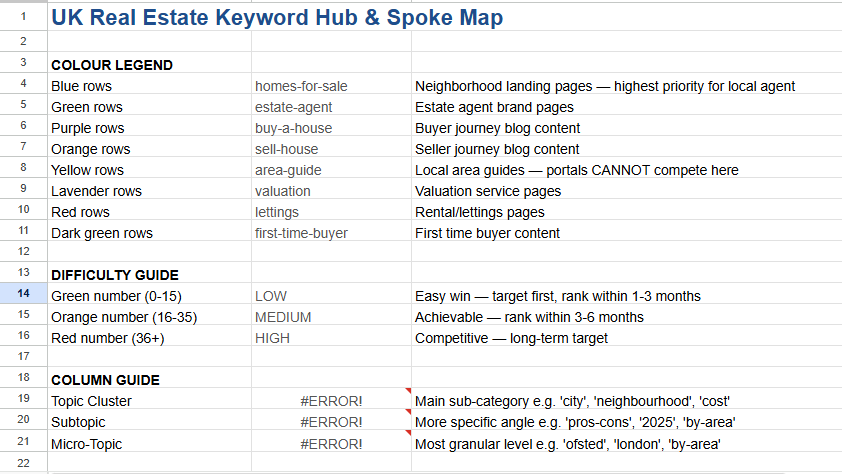
Rather than publishing random blog posts, I built a hub-and-spoke content architecture specifically for local real estate SEO:
- Hub Pages: One dedicated landing page per target neighborhood (e.g., “Homes for Sale in [Neighborhood]”)
- Spoke Articles: Supporting blog content targeting buyer-intent questions that linked back to the hub pages
- City Guide Page: A comprehensive “Living in [City]” resource page targeting informational searchers at the top of the funnel
Phase 2 — Content Creation
Neighborhood Landing Pages
The first content deliverables were 6 neighborhood-specific landing pages. These pages were designed to rank for “[neighborhood] homes for sale” keywords and convert visitors into leads.
Each page followed a proven structure:
- A compelling intro with the neighborhood name and city in the H1
- Current market snapshot (median price, average days on market, inventory)
- What makes this neighborhood unique — schools, walkability, lifestyle
- Types of homes available (condos, single-family, new builds)
- A lead capture form: “Get New Listings in [Neighborhood] Sent to Your Inbox”
- Internal links to related neighborhoods and blog content
Blog Content — Targeting Buyer Questions
Alongside the neighborhood pages, I built out a content calendar of 12 blog articles targeting buyer-intent search queries. Examples included:
- “First-Time Home Buyer Guide for [City]: What to Know Before You Buy”
- “Best Neighborhoods in [City] for Families in 2024”
- “[City] vs. [Nearby City]: Which Is Better for Buyers?”
- “How Much Do You Need to Buy a Home in [City]?”
- “What Is the Real Estate Market Like in [City] Right Now?”
Every piece of content was written to serve real buyer questions, optimized for a primary keyword, and structured with proper H1/H2/H3 hierarchy, meta descriptions, and internal linking back to the neighborhood pages.
Phase 3 — On-Page SEO & Technical Fixes
Website Audit Findings
Before publishing new content, I audited the existing website and found several issues that were suppressing rankings. The most critical were:
- Missing or duplicate meta titles and descriptions on all service pages
- H1 tags absent on 60% of pages
- No internal linking structure — pages were isolated silos
- Images had no alt text, impacting both SEO and accessibility
- The homepage had only 180 words of content — well below what Google needs to understand the page’s topic
- Mobile load speed: 6.2 seconds (target: under 2.5 seconds)
On-Page Optimizations Applied
For every existing page and all new content, I applied a consistent on-page SEO framework:
- Title Tags: Keyword-first, under 60 characters, including city name
- Meta Descriptions: Written to drive clicks with a clear value proposition
- Header Structure: One H1 per page with target keyword, logical H2/H3 hierarchy
- Internal Linking: Every blog post linked to at least 2 neighborhood pages; every neighborhood page linked to related blog content
- Image Optimization: All images compressed and tagged with descriptive alt text including location keywords
Phase 4 — Local SEO & Google Business Profile
Google Business Profile Optimization
For a solo real estate agent, Google Business Profile (GBP) is one of the most powerful and underutilized SEO tools available. I rebuilt the client’s GBP from scratch:
- Updated all NAP information (Name, Address, Phone) to be consistent across the web
- Added all relevant service categories: Real Estate Agent, Real Estate Consultant, Buyer’s Agent
- Wrote a fully optimized business description incorporating target keywords naturally
- Uploaded 25 high-quality property and headshot photos
- Set up a weekly GBP Post schedule — each new blog post was summarized in a GBP Post with a link back to the full article
- Responded to all existing reviews and implemented a review request process for past clients
Local Citation Building
I audited and cleaned up the client’s presence across 40+ local directories including Yelp, Zillow, Realtor.com, Homes.com, and local Chamber of Commerce listings. Consistent NAP data across these citations is a key local ranking signal.
Phase 5 — Results
Organic Traffic Growth
The table below reflects data pulled directly from Google Search Console over the 5-month engagement:
|
Month
|
Organic Sessions
|
Top 10 Keywords
|
Impressions
|
|---|---|---|---|
|
Month 1 (Baseline)
|
82
|
0
|
1,200
|
|
Month 2
|
190
|
3
|
8,400
|
|
Month 3
|
410
|
9
|
22,000
|
|
Month 4
|
620
|
14
|
41,000
|
|
Month 5
|
361*
|
17
|
58,000
|
*Month 5 data captured mid-month at time of reporting. Full-month projection: ~720 sessions.
Keyword Rankings
By Month 5, the client was ranking in the top 10 for 17 keywords — up from zero. Key wins included:
- [Neighborhood A] homes for sale → Position #3
- [Neighborhood B] real estate → Position #5
- best neighborhoods in [City] for families → Position #4
- first time home buyer guide [City] → Position #6
- how much to buy a house in [City] → Position #7
Business Impact
Beyond traffic and rankings, the most important outcome was lead quality. The client reported:
- 3 inbound leads directly from the neighborhood landing pages in Month 4
- 1 closed transaction ($385,000 sale) attributed to a buyer who found the agent through the blog
- A reduction in Facebook ad spend from $1,100/month to $400/month as organic leads increased
- Google Business Profile calls increased by 210% over the engagement period
Key Takeaways
This case study demonstrates a repeatable framework for helping solo real estate agents compete in crowded local markets without relying on paid ads:
- Niche down, not out: Big portals cannot dominate hyper-local neighborhood-level keywords the way a local expert can.
- Content architecture matters: A hub-and-spoke model connecting neighborhood pages to blog content builds topical authority faster than isolated posts.
- Google Business Profile is free leverage: Most agents set it up once and forget it. Regular posts, photos, and review management create a compounding local SEO advantage.
- On-page fundamentals unlock everything: Fixing basic issues (missing H1s, no meta descriptions, no internal linking) often produces the fastest early ranking gains.
- SEO compounds over time: Month 1 showed minimal movement. By Month 5, the site had built enough authority that new content was indexing and ranking within weeks.